Athens Writes Back

I have loved Athens long enough to stop seeing it as a collection of sights. I return for the light, the noise, the smells (yes, really), the disorder, the souvlakia at O Thanasis, and the peculiar sense that every surface has accumulated more history than it can comfortably hold. Yet, for all the photographs I have taken here, I somehow kept walking past its street art. It took me long enough to stop and give it the attention it deserved, even if this is but a very thin slice of what’s there. This is on purpose – this way, I can sell “Need to take more pictures of street art” as a reason to disappear there for a week or several.
This time, I had a rental flat in Psyrri – as good a place to start as any. I followed a loose trail of painted walls: gods and monuments, managers and protesters, tenderness, anger and a dog who became a symbol of resistance. These works are not simply decoration laid over Athens. They are part of the way the city remembers, argues with itself and continually paints over its own history.
Reclamation
Let’s start with a bit of meta street art: A young woman spray paints the Acropolis, turning Athens into both subject and canvas. To me, this looks less like rejection of the ancient monument than reclamation. The old stones are taken back and remade through contemporary means.
She simultaneously appears to spray paint the Acropolis pink, and to spray paint the Acropolis into existence. There is no verified artist’s statement attached to this particular work, so “the younger city recreating the ancient one” is my own interpretation.
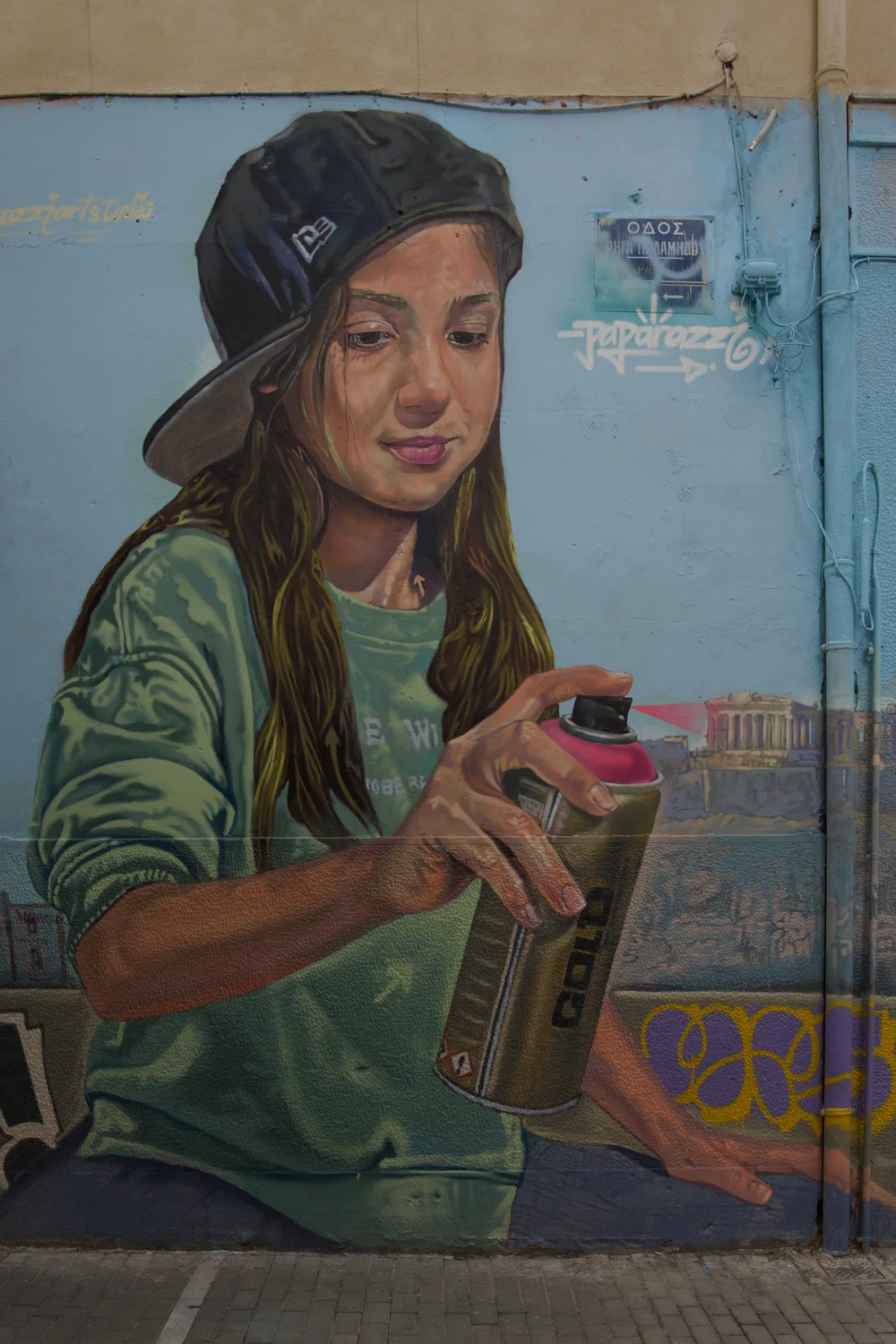
| Artist | Achilleas Michaelides, known as Paparazzi. Born in Tbilisi in 1982, grew up in Thessaloniki and encountered graffiti culture there around 1997. Based in Cyprus since 2002, he considers himself largely self-taught and works across murals, painting and art made from discarded materials. His highly modelled, realistic style consciously bridges graffiti and traditional figurative painting. |
|---|---|
| Painted | Most probably 2018; it belongs to the group of Paparazzi works that appeared in Psyrri that year. It is generally catalogued as Untitled. |
| Location | Corner of Sarri and Riga Palamidou, right across from the Loukanikos mural |
Vigil
In German, an expression for doing something unnecessary is “Eulen nach Athen tragen” - to carry owls to Athens. The owl is indeed omnipresent in the city, and has been for more than two and a half millennia. Sacred to Athina, the city’s patron goddess and the goddess of wisdom, it had become an emblem of Athens by the late sixth century BCE, when it appeared on widely circulated Athenian silver coins. The same ancient owl appears today on the Greek one-euro coin – and on a street corner in Metaxourgeio.
Painted for the Little Paris of Athens festival, the mural takes its title from the phrase commonly attributed to Jimi Hendrix: “Knowledge speaks, wisdom listens.” The owl invokes Athina and the traditional emblem of wisdom, but its confrontational gaze makes it less a passive symbol than a watcher examining the city. WD said Greece was passing through a dark period and needed to recall the owl’s wisdom.
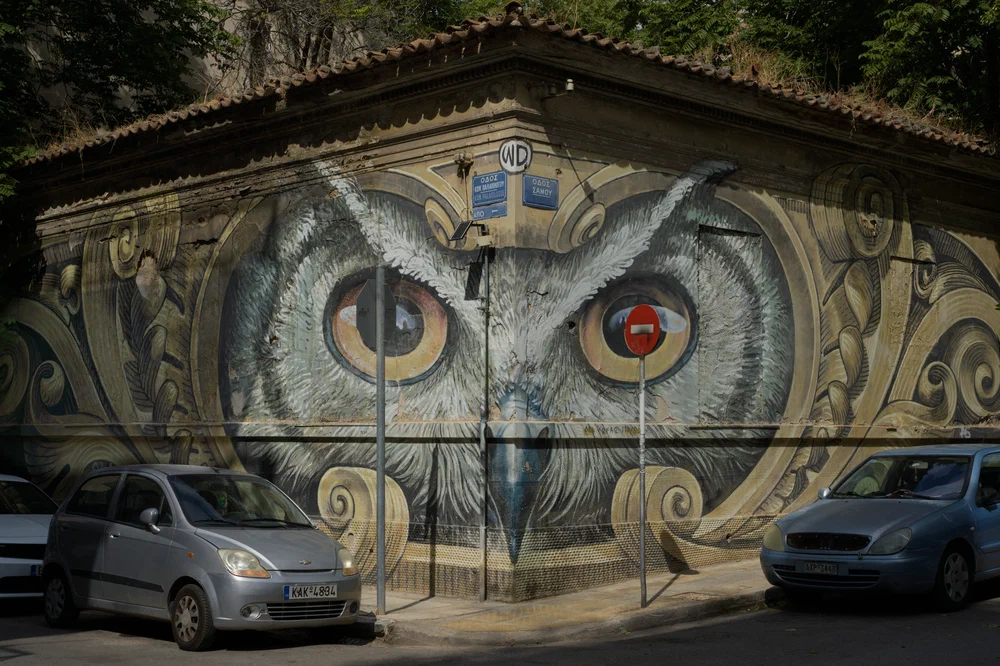
| Artist | WD, or Wild Drawing. Born and raised in Bali, studied Fine and Applied Arts and began working on the street in 2000. Based in Athens, he combines photorealism with imagery drawn from comics and from his East–West cultural background, often designing murals around the architecture and deterioration of the wall itself. |
|---|---|
| Painted | 2016 |
| Location | Corner of Samou and Konstantinou Palaiologou, Metaxourgeio |
Lament
This is the first of what will be several large paintings by INO. I like his style, both the execution and the sentiment behind it. The mural shows three Caryatids, with tears in their eyes (formed by INO’s signature light blue splash).
The three figures all mourn different things: According to INO, the left-hand figure represents “Kori C”, stolen by Lord Elgin along with a large amount of the Acropolis frieze – now in the British Museum. She looks back to the Acropolis and longs to be home. The right-hand figure faces Syntagma, the seat of the Greek Parliament, and cries in condemnation of contemporary politics, and the central figure looks out over Athens and Greece as a whole and bemoans the condition of the country and her disappointment with modern democracy.
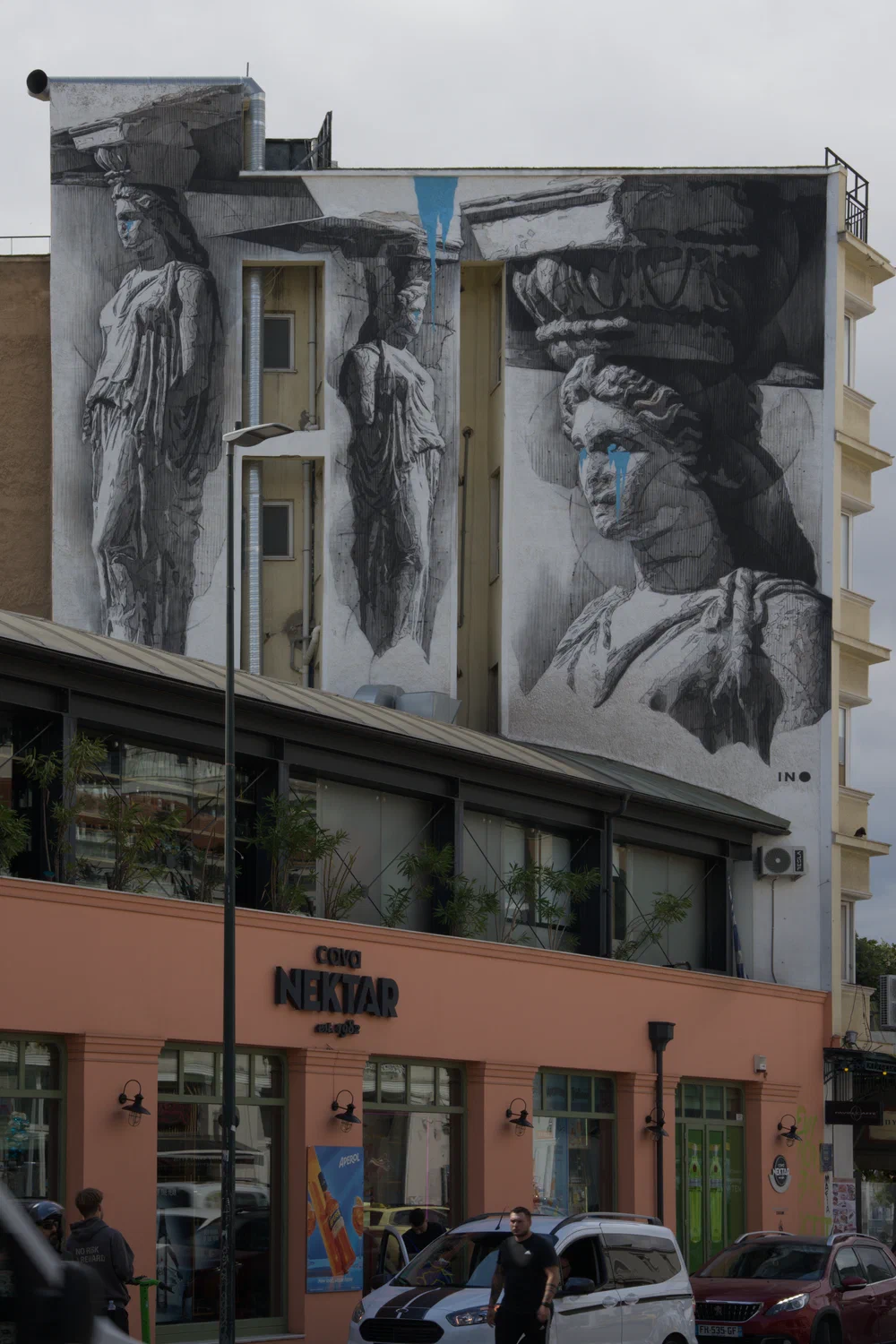
| Artist | INO, a private, pseudonymous artist from Piraeus who began writing graffiti around 2000 and later studied painting at the Athens School of Fine Arts. He is known internationally for monumental figurative murals composed of fragmented greyscale forms, usually interrupted by a small amount of light blue. |
|---|---|
| Painted | During the second half of 2023; unveiled publicly in early 2024 |
| Location | Ermou 121, at Astiggos, Monastiraki |
| Production | It formed part of the City of Athens Public Murals programme, curated by Katerina Koskina. INO worked suspended from ropes, completing it over approximately 25 working days. |
Collapse
Another work by INO: “System of a Fraud”. The face is Solon, the ancient Athenian lawgiver associated with reforms intended to resist political, economic and moral decline. INO divides the portrait into two connected but collapsing halves, representing what he called the two sides of Greece’s corrupt contemporary political system. The title therefore carries a bitter historical comparison: the founder of a legal order presiding over its deterioration.
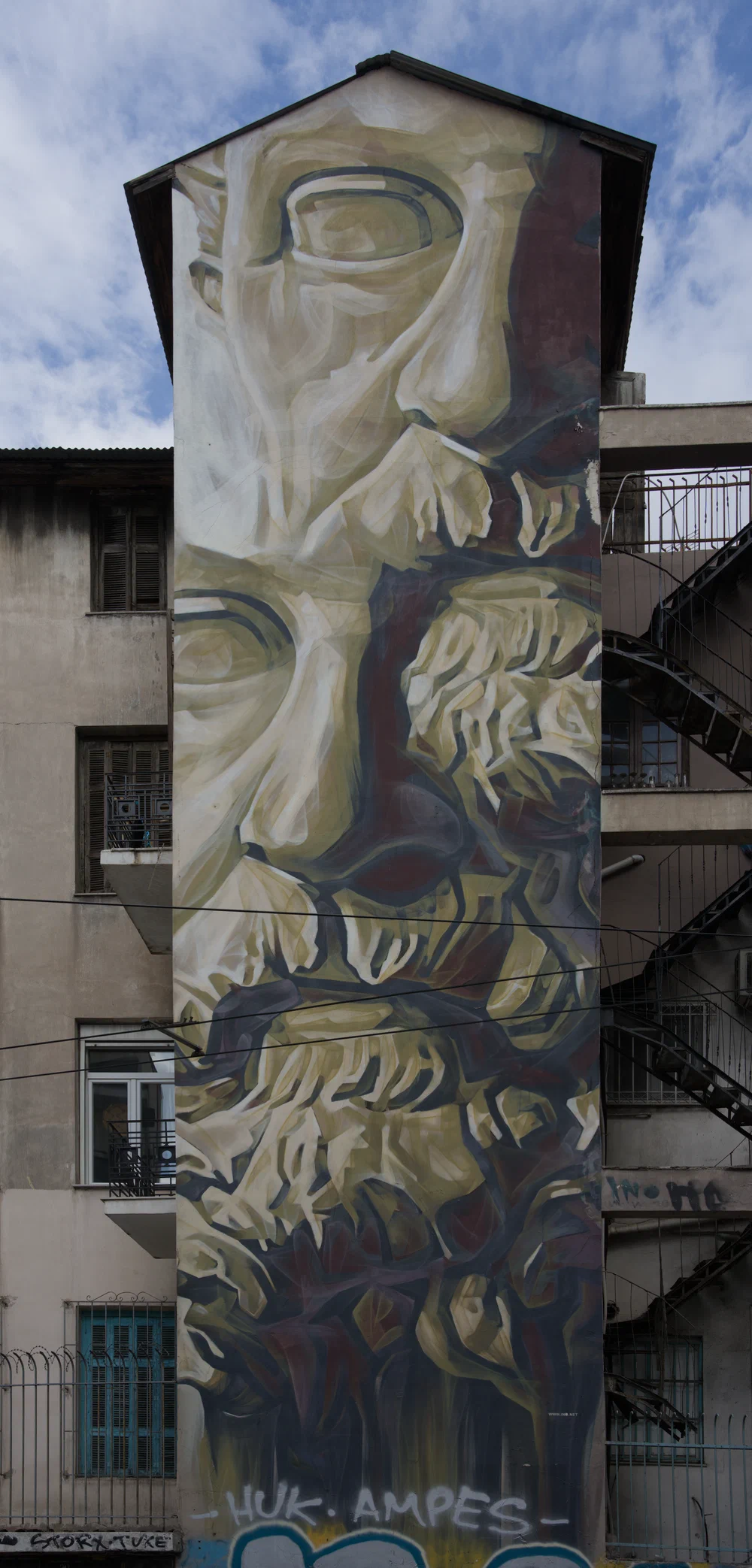
| Artist | INO. One of his early works: the fragmentation and political allegory are already present, but the restrained monochrome-and-blue vocabulary of his later murals is not yet fully established. |
|---|---|
| Painted | November 2013 |
| Location | Achilleos Street, Metaxourgeio |
Compliance
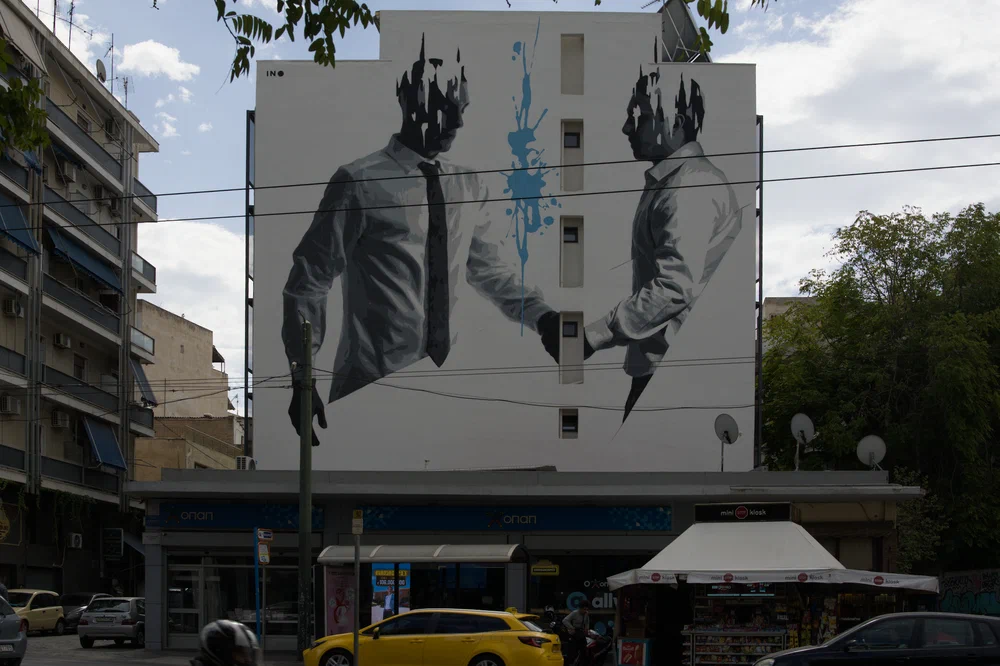
Just down the road from “System of a Fraud” is a more recent INO mural, this time showing his signature monochrome style with its light-blue splash. “The Managers” shows two men in business attire. Their faces are dissolving almost to the point of anonymity. They seem to be sealing an agreement with a handshake – but something is slightly off. I only noticed it later, while processing the photograph: they are shaking left-handed, turning the familiar symbol of trust into something suspect – “sinister” in its original Latin meaning. The choice appears deliberate, but its interpretation remains open.
The blue accent sits between the two men, simultaneously separating them and suggesting a signature or seal.
The position above an “OPAP” betting shop is almost too perfect – beneath the managers and their sinister agreement, everybody is invited to take their chances. The shop was there when INO painted the mural, so this could well be part of the overall design.
| Artist | INO |
|---|---|
| Painted | September 2022; completed in roughly one month |
| Location | Iasonos 47, Metaxourgeio |
Defiance
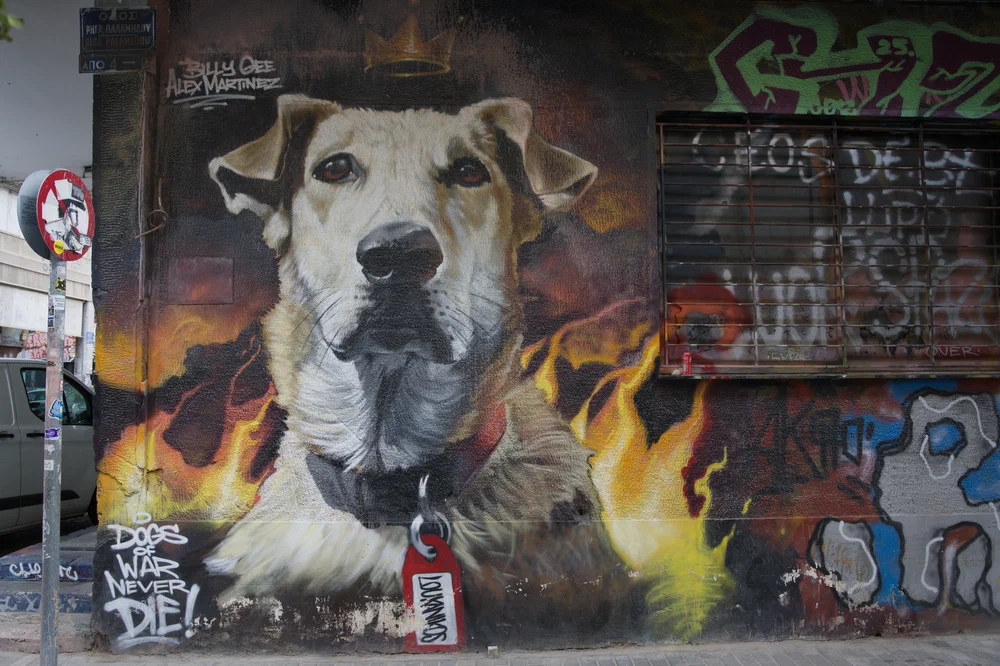
This is one of my favourite murals of this series. Compared to the others, it’s relatively small scale, but it captures a slice of Athens extremely well. This is “Loukanikos” (“Sausage”), an Athenian stray born around 2004 and closely associated with Exarcheia. In the civil unrest of 2008, Loukanikos appeared at demonstrations, strikes and confrontations throughout central Athens. During the most intense years of the financial crisis he became a fixture at Syntagma Square: running alongside marches, standing between protesters and riot police, barking at police lines and occasionally chasing tear-gas canisters.
His behaviour was strikingly consistent. Photographers repeatedly caught him facing the riot police rather than the demonstrators, sometimes several metres ahead of the human crowd. This created the irresistible image of a dog who had consciously chosen a political side.
By 2010 his photographs and videos were circulating internationally. During the vast anti-austerity protests of 2011, he became one of the most recognisable images of the Greek crisis. TIME published an article about him as part of “The Protester”, the magazine’s 2011 Person of the Year.
The mural was painted shortly after his death became publicly known in 2014. The original version said “All dogs go to heaven” in the lower left corner, and “Τα δακρυγόνα μαζί τα φάγαμε” (We ate the tear gas together), a pointed inversion of Theodoros Pangalos’s notorious “Μαζί τα φάγαμε” (We ate it together), which unfairly distributed responsibility for Greece’s public spending and debt across politicians and citizens alike.
| Artists | Billy Gee, Alex Martinez and N_Grams – Billy Gee is Vasilis Griparis, an Athens visual artist, graphic designer and major figure in Greek skate and graffiti culture since the 1990s. N_Grams is Dimitris Naiplis; Alex Martinez is another longstanding mural and graffiti artist. Their collaboration gives the work the character of a collective street tribute rather than a commissioned monument. |
|---|---|
| Painted | October 2014 |
| Location | Riga Palamidou and Sarri, Psyrri – opposite “Girl spray-painting the Acropolis” |
Delirium
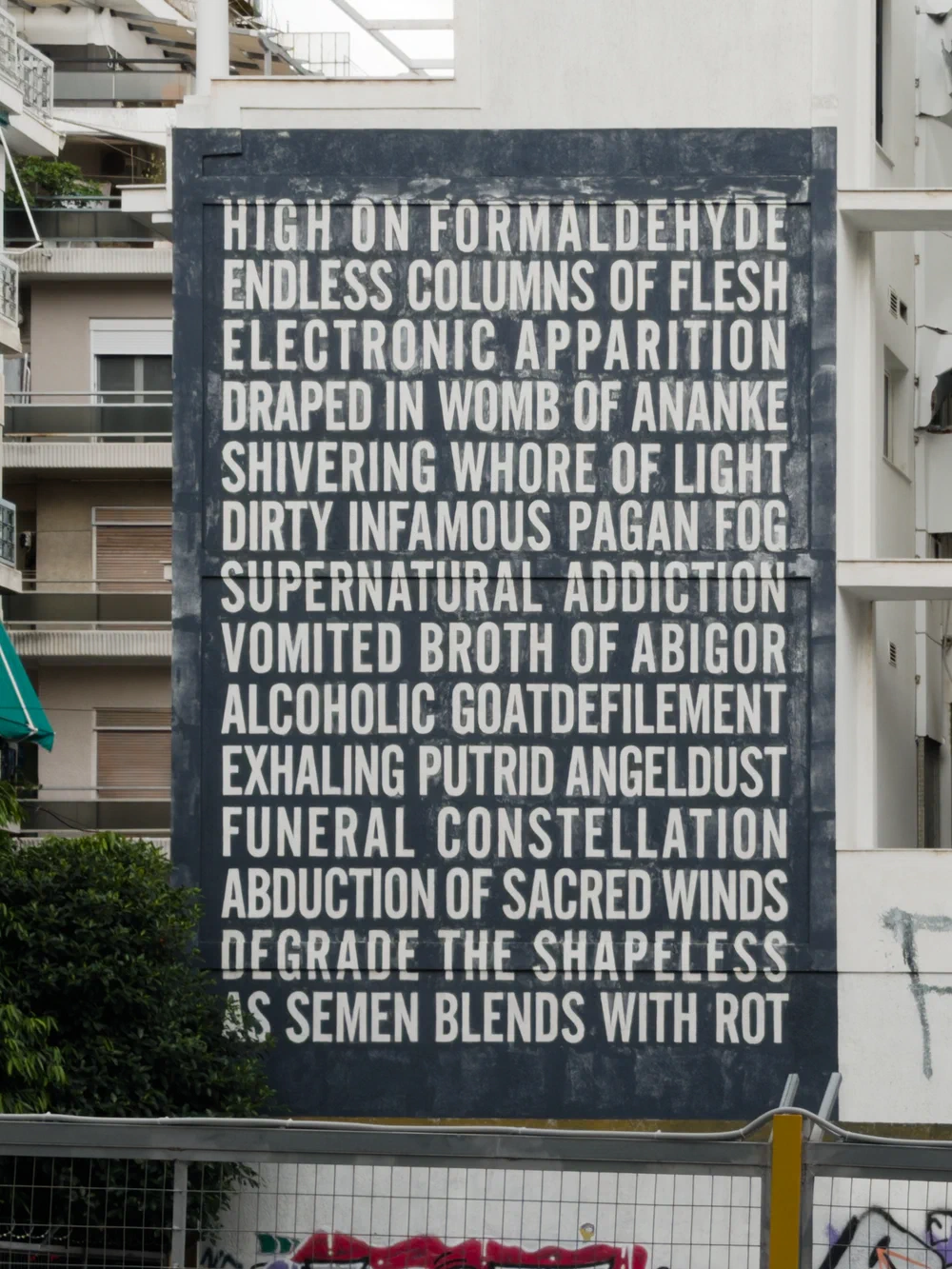
This is one of the walls I regularly walk past in Psyrri. What initially looks like an unusually literary piece of anonymous street art is actually “Poem for Athens”, a 2009 work by Canadian artist Steven Shearer. Its opening line, “High on formaldehyde”, begins a feverish litany assembled from the grotesque language of heavy-metal lyrics and song titles. Shearer enlarges this vocabulary of putrefaction, paganism and bodily horror into monumental public poetry, setting its vivid imagery against severe white-on-black typography. The result is simultaneously repellent, absurd and strangely unforgettable.
| Artist | Steven Shearer – Canadian, born in New Westminster in 1968; lives and works in Vancouver. Shearer explores youth, alienation, art history and heavy-metal subculture. He represented Canada at the 2011 Venice Biennale. |
|---|---|
| Date | 2009 |
| Location | Corner of Korinis and Sapfous, Psyrri |
| Production | Created for “Until the End of the World”, an exhibition at AMP Gallery, Athens |
Contact
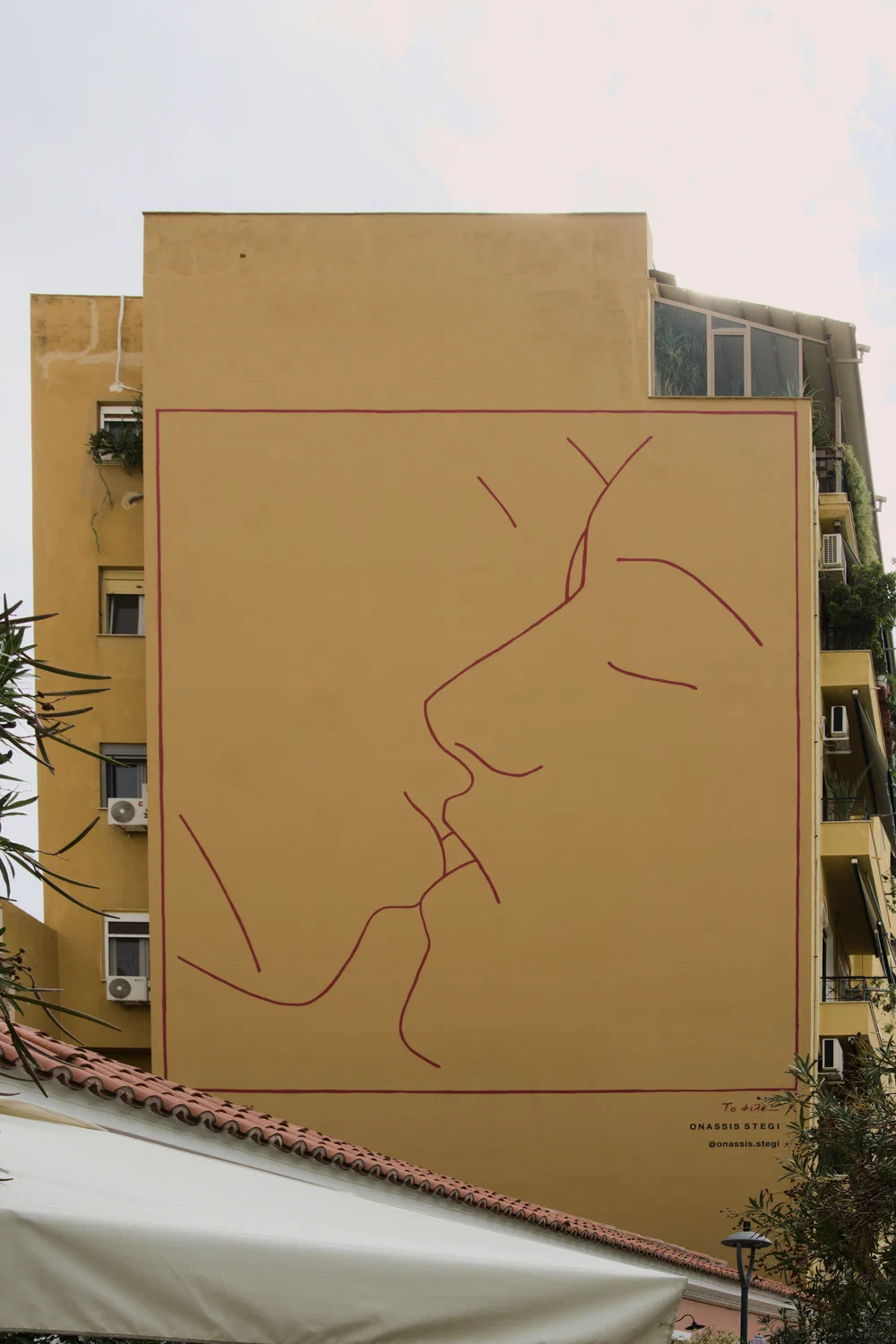
I can’t end this post on collapse of the system, fraud, faceless managers, a stolen Caryatid, an austerity crisis and alcoholic goatdefilement. So here’s “The Kiss”, which feels like the city is finally taking a breath. Painted in 2021, it enlarges a 2019 work by Cretan-born Greek artist Ilias Papailiakis.
Commissioned by the Onassis Foundation in collaboration with the City of Athens during a period of social distancing, it turns an intimate gesture into a public monument.
Papailiakis reduces the figures to a handful of broad, flowing lines. There is no setting, no story and little indication of identity: only two people and their recognition of one another. The artist describes the work in terms of love, desire, tenderness, proximity and awareness of the other. On the blank side of an apartment block, it offers no argument and demands no explanation. After all the anger, decay and accusation on the preceding walls, this seemed the right place to end: with Athens, briefly, being gentle.
| Artist | Ilias Papailiakis – born in Crete in 1970, studied at the Athens School of Fine Arts, represented Greece at the 2001 Venice Biennale and participated in documenta 14. He is an established gallery painter and Associate Professor of Architecture at the University of Patras—not principally a street artist. |
|---|---|
| Painted | Original: 2019, mural: 2021 |
| Location | Giatrakou 9, Avdi Square, Metaxourgeio |